

.jpg)
.jpg)
The Apiary and Bee Museum at The Oaks
A working apiary and permanent educational museum for guests exploring bees as honey-makers, pollinators, and ecologically vital insects. Honey production forms part of the story, connecting real beekeeping practice with science, conservation, and culture. Some of our zones highlighted below.
An award-winning immersive experience, free for all overnight guests.

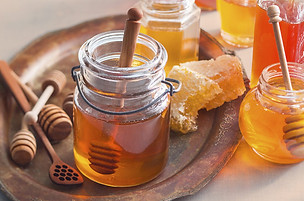
Cedar Hollow Honey Tasting
Discover the delicate flavours of our local honey and learn to identify spring honey, rich summer honey, smooth creamed honey and fresh honeycomb, alongside a blind tasting comparing raw honey with commercial alternatives.
Served with sourdough crackers, apple slices, dried figs, a selection of cheese and sparkling honeyade. Add home made honey ice cream and discover honey wine (mead) as optional add-ons.
A delightful journey into the world of bees, blossoms and truly local honey.


Zone 1 : Main Exhibit - The Oaks Apiary
The foundation of our collection: a working apiary producing hyper-local, raw honey. The Bee Museum is in fact where we spin our honey. This is where our exploration of bee biology, vision, communication, and survival begins
-
The Provenance: Our active hives are nestled among the rewilding meadows and orchards of The Oaks estate. Unlike commercial blends, our honey is a "time capsule" of the Oxfordshire landscape. Its flavour profile shifting seasonally based on the native wildflowers, fruit trees, and hedgerow blossoms our bees forage.
-
Raw & Unfiltered: We practice ethical beekeeping in line with British Beekeepers Association (BBKA) standards. Our honey is never pasteurised, preserving the natural enzymes, pollen, and propolis that are often lost in mass production.
-
Taste the Landscape: Guests are invited to experience this "living exhibit" firsthand. Our raw honey is served daily at breakfast and available for purchase, directly supporting our biodiversity projects.


Zone 4 : The Current Threat
A dedicated educational zone focusing on the greatest modern threat to UK pollinators: the Yellow-Legged Asian Hornet (YLH).
-
The UK Invader: Specimens of the YLH are displayed alongside our native European Hornet, allowing visitors to learn clear visual identifiers
-
The "Heat Ball" Defence: A dynamic display illustrating how Asian Honey Bees have evolved to protect their hive which the European Honey Bee is unable to do
-
Invaders Around the World: We broaden the lens to examine invasive species globally, including the Asian “Murder” Hornet, with specimens explaining how early detection and a coordinated response led to its successful eradication from North America.
Citizen Science: Join the Fight! Our UK bees are unable to defend against YLH. As active members of the British Beekeepers Association (BBKA), The Oaks supports the national eradication effort. We encourage all visitors to download the official 'Asian Hornet Watch' app to report sightings directly to the National Bee Unit.


Zone 5 : Colonial Science
Much of what we call scientific discovery did not happen in empty places. This zone explores insects that entered Western science through colonial routes: collected, named, and removed from ecosystems that already understood them. It asks one simple question:
Who gets to name nature?
-
The King of Wasps: The Garuda Wasp (Megalara garuda), formally described in 2012 from specimens long held in museum collections. Its reputation is built on appearance alone - no living behaviour has ever been recorded.
-
The World's Largest Bee: Wallace’s Giant Bee (Megachile pluto), first "discovered" in 1858 but thought to be extinct for decades until its dramatic rediscovery in 2019. To local communities, it was never lost.


Zone 6 : Nature’s Grim Reapers
A look at the complex, often macabre reproductive strategies of the insect world. These are the real-life inspiration for science fiction horror.
Featured Specimens include:
-
The Zombie Maker: The Emerald Cockroach Wasp (Ampulex compressa). We learn how this jewel-toned wasp performs "brain surgery" on a cockroach, stinging it in a precise neural spot to remove its free will before leading it to a burrow like a pet on a leash.
-
The Tarantula Slayer: The Tarantula Hawk Wasp (Pepsis grossa). A display highlighting the sheer power required to hunt tarantulas, dragging them to a burrow to serve as a living larder for a single egg.
These are just two examples - the full section reveals many more strategies that blur the line between life and horror.


Zone 8 : Adaptation & Disguise
Sometimes, survival depends on deception, imitation, and unlikely alliances.
-
Chemical Mimicry: The Death’s-head Hawkmoth, famous for the skull-like marking on its thorax. Displays explain its mastery of chemical camouflage, allowing it to slip past guard bees and raid hives for honey.
-
Evolutionary Mimicry: Interpretive displays on Batesian and Müllerian Mimicry, demonstrating how harmless species (like hoverflies and moths) gain protection by visually mimicking the warning colours of stinging insects like bees, wasps and hornets.
-
Mutualism: Cooperative relationships where survival improves for all involved, from the fig and its wasp, locked into a shared reproductive cycle, to the honeyguide bird, which actively leads honey badgers to wild bee nests.


Zone 7 : Enemies of the Hive
Bees have never lived in isolation. For millions of years, they have existed alongside predators, parasites, and pathogens with each playing a role in the wider ecosystem.
Featured examples include:
-
The Butcher Bird (Shrike) : A rare Victorian taxidermy illustrating a specialised hunting strategy: impaling prey on thorns to store and consume later in a makeshift "larder", earning its nickname “the butcher bird.”
-
Other Avian Specialists : Bee-eaters, honey buzzards, and hoopoes, shown through mixed media and artistic recreations, revealing the anatomical adaptations that allow birds to safely hunt and consume stinging insects.
-
Invertebrate Threats : From wax moths that infiltrate hives to velvet ants and parasitic fungi that exploit bee life cycles from within.
All specimens and objects displayed in the Bee Museum are ethically sourced and responsibly acquired. The Museum does not collect live insects for permanent display and prioritises transparency, conservation and education.
Honey, Biodiversity and Land Stewardship
Our honey is more than a sweet indulgence - it is a commitment to biodiversity. Bees are the custodians of the natural world, and a thriving bee population is the heartbeat of a healthy ecosystem.
At Cedar Hollow, we have cultivated a true sanctuary for pollinators. By sowing native wildflowers, orchards and managing our land with sustainability at the forefront, we ensure our bees flourish. Every jar you enjoy directly supports this delicate, thriving balance.
As proud members of the British Beekeepers Association, we adhere to ethical practices that prioritise the welfare of our colonies and the landscape they call home. Cedar Hollow is a Gold Award recipient of Green Tourism UK, recognising our commitment to sustainability and responsible land stewardship.
Trustees
.jpg)
.jpeg)
Dr Yaz
Curator

Dr Roy
Beekeeper

Gabs
Consultant Ecologist
.jpeg)
Mimzo
Beekeeper
The Bee Museum at The Oaks is a permanent, public-facing museum and member of the Association of Independent Museums.
(Membership Number 8369)


The Artists Behind the Bee Museum
The Bee Museum has been brought to life by artists, makers, scientists and naturalists, each adding a little wonder to this hidden world of bees.


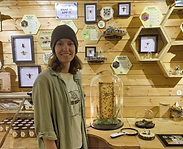

Lucy Green
Artist
Matthew Crabb
Chainsaw Carver
Paul
Insects of Beauty
Sanne de Jong
Entomologist
With special thanks to Lucy Green for the nectar guide flowers, Matthew Crabb for the Honey Badger carving, and Sanne de Jong for the beehive display, heat ball and bespoke natural history displays. Many thanks also to Paul of Insects of Beauty for helping us source carefully preserved educational specimens from around the world.
We are also grateful to Michael Nagan for the magnificent Honey Buzzard sculpture,